
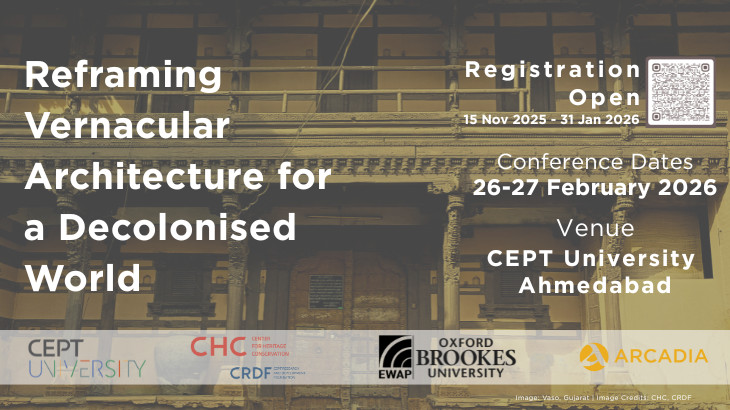
Reframing Vernacular Architecture for a Decolonised World
Event
Thu, February 26, 2026 - Fri, February 27, 2026
CEPT University, Ahmedabad, India
Registration ClosedVernacular architecture is broadly defined as encompassing dwellings and structures built by a community, using local materials and traditional techniques, to meet their specific needs and reflect their environment and way of life. It is often, quite uncritically, described as architecture produced by ‘natives’, or emerging from the practical needs and traditions of a community, rather than being a result of a systematic design thinking process. However, examples of ‘vernacular architecture’ from across the world have demonstrated that this kind of built environment is often the result of the amalgamation of various cultural influences and emerges from the sophisticated understanding of materials, structure, and craft. The domestic nature of much of this architecture, coupled with a colonial gaze, has historically Othered it and overlooked the valuable lessons it may provide in the fragile and unpredictable world we live in.
This conference, jointly hosted by Oxford Brookes University, UK, and CEPT University, Ahmedabad, India, seeks to explore and rethink the meaning of vernacular architecture in a decolonised world. The conference is expected to produce a critical publication on the subject that will be edited by experts appointed by both organising institutions.
Thematic areas:
- Language and Meaning: Ranging from the meaning of the term ‘vernacular’ to the terminologies within the architectural language, and the meanings embedded within the architectural language itself, this thematic area invites scholars from various backgrounds to reflect and position their research in the broad context of this conference. Within this thematic area, scholars could deep-dive into linguistic and etymological studies that may reveal the geographical and architectural relationships of terms used for spaces, elements and building processes. Papers presenting architectural studies analysing the language of structure and ornamentation are also included under this thematic area, especially when uncovering meanings related to the life-worlds they are situated in.
- Production and Use: The question of colonial gaze towards the notion of ‘vernacular architecture’ is most pronounced in the way its production (spontaneous, uncritical) and use are understood and reiterated through various scholarly studies. As a part of this thematic area, studies by practitioners, researchers, and scholars that specifically look into the processes of ‘making’, either as typologies, materials, structural systems, craft practices, resource systems, knowledge systems, financial mechanisms, or as experiments in modern adaptations, are invited.
- Documenting and Archiving: In calling to imagine a decolonised world, it is important to reflect upon the core foundations of the discipline that records, documents and archives the built environment as objects for research or valorisation. On the one hand, a digital future with open-access databases promises better accessibility to research records, but on the other hand, it raises ethical issues of authorship. Papers in this thematic area ask fundamental as well as methodological questions about this ambivalence.
- Valuing, Conserving and Adapting: ‘Vernacular architecture’, when valued, is seen as a repository of ‘traditional wisdom’ that may be useful for a sustainable future, and potentially a challenge (or an alternative) to the architecture produced by the modern, industrialised world. Papers and presentations in this thematic area are expected to be critical views of practitioners and experts on the philosophical and technical positions taken while conserving the architecture broadly catagorised as ‘vernacular’. Critical feedback on doctrines and dogmas established around conservation and adaptation of ‘vernacular architecture’ for future generations, through case studies, or by presenting a deep reading of the doctrinal text, is also welcome.
SUBMISSION FOR ABSTRACTS IS CLOSED
Partnering Institutions:
Oxford Brookes
Based in Oxford England, Oxford Brookes University is a renowned public university, with a local, national and international reputation for teaching and research excellence. Having been established in 1865 as a small School of Art, the University has over 150 years history, and has gained a reputation for research-led practical learning, and professional development, and offers a diverse range of undergraduate and postgraduate programs across fields such as health and social sciences, business, engineering, arts, and technology. The School of Architecture has a national and international reputation for education and research that has a strong focus on sustainability, social responsibility, and creative problem-solving. The school is renowned for its strong links to industry, including collaborative research and real-life project engagement for students.
CEPT University
CEPT University focuses on understanding, designing, planning, constructing and managing human habitats. Its teaching programs aim to build thoughtful professionals, and its research programs deepen understanding of human settlements. CEPT University also undertakes advisory projects to further the goal of making habitats more livable. Through its education, research and advisory activities, CEPT strives to improve the impact of habitat professions in enriching the lives of people in India's villages, towns and cities. CEPT University takes its name from the ‘Center for Environmental Planning and Technology (CEPT). In 2005, the Government of Gujarat incorporated CEPT as a university. It was recognised by the University Grants Commission since 2007 under section 2(f) of the UGC Act, 1956. CEPT University was also recognised as a Scientific and Industrial Research Organization (SIRO) by The Department of Scientific and Industrial Research (DSIR) of the Government of India and comprises of five faculties: The faculty of Architecture (1962), Faculty of Planning (1972), Faculty of Technology (1982), Faculty of Design (1992), and the Faculty of Management (2013)The University does not have any branches or any affiliated colleges.
EWAP
The Endangered Wooden Architecture Programme (EWAP) is a cultural grants programme that has been offering small and large grants for the documentation of endangered wooden architecture. The programme is hosted by Oxford Brookes University and delivered in collaboration with CyArk. EWAP was established in 2021 with funding from Arcadia, a charitable foundation that works to protect nature, preserve cultural heritage and promote open access to knowledge. Recognising the urgent need to document the endangered wooden architectural heritage before much of it disappears due to the combined forces of globalisation, deforestation and material transience, the programme has been creating a long-term open-access digital repository, and through documentation and fostering new collaborations and initiatives, aims to raise awareness and appreciation of the value and significance of wooden architecture around the world.
CHC, CRDF
Center for Heritage Conservation (CHC) focuses on advancing the discourse of built heritage conservation through the lenses of sustainability and equity, considering the challenges faced by the Global South. The Center collaborates on the most pioneering international research projects on the one hand and engages with the government, city administration, and industry on the other to inform policies and practices on the ground. The team at CHC approaches conservation as a comprehensive process that is situated in an ever-changing environment and constantly engages with all actors and stakeholders that are a part of that change. The educational activities conducted by the CHC team are recognised as one of the best practices internationally. CHC collaborates with a range of international, national and regional institutions and organisations.
CEPT Research and Development Foundation (CRDF) is a multidisciplinary think-do-tank promoted by CEPT University. After more than four decades of consultancy, research, and advisory work, the university established CRDF in 2013 under Section 8 of the Companies Act 2013 (non-profit company) to undertake and manage the increasing volumes of research work in the domain. It is a wholly owned but separate entity of CEPT University, Ahmedabad.
CRDF, through its Centres, strives to enhance and deepen knowledge, encourage innovation, and provide professional services. The different thematic verticals, identified as 'Centers,' work together to find answers to complex problems in the built environment. CRDF works in the areas of Urban Planning and Policy, Infrastructure Development, Water and Sanitation, Heritage Conservation, Climate Change, Sustainable Living, Affordable Housing, Advanced Geomatics, Building Science and Energy, and Urban Transportation.
Registration Categories and Fees
Please select the appropriate category to proceed with your registration for Reframing Vernacular Architecture for a Decolonised World.
The fees are inclusive of applicable taxes.
Category | Fee (INR) |
|---|---|
Student (India) | 3,800 INR |
International Student | 4,000 INR |
Professional (India) | 6,200 INR |
International Professional | 6,700 INR |
* Registrations will close on 31 January 2026
For Paper Submitters
| Milestone | Date |
|---|---|
| Announcement of Call | 30 August 2025 |
| Last Date to Submit Abstracts | 15 October 2025 |
| Communication of Selection for Conference | From 15 November 2025 onwards |
| Final Schedule Announcement | 15 December 2025 |
| Last Date to Submit Final Papers (for Selected Presenters) | 30 April 2026 |
| Editing and Preparation of Final Manuscript for Publication | April–December 2026 |
For Registrants
| Milestone | Date |
|---|---|
| Registrations Open | 18 November 2025 |
| Registrations Close | 31 January 2026 |
Scientific Committee
- Aylin Orbasli (PhD), Professor, Architecture and Urban Heritage, Oxford Brookes University
- Christina Godiksen (PhD), Head of School, School of Architecture, Oxford Brookes University
- Gauri Bharat (PhD), Professor and Dean, Anant University
- Jay Thakkar, Sr Associate Professor, Faculty of Design, CEPT University
- Jigna Desai (PhD), Professor, Faculty of Architecture, CEPT University
- Marcel Vellinga (PhD), Professor, Anthropology and Architecture, Oxford Brookes University
- Orit Sarfatti (PhD), Senior Lecturer, Oxford Brookes University
- Shubhra Raje, Adjunct Professor, Faculty of Architecture, CEPT University
- Sonal Mithal (PhD), Adjunct Associate Professor, Faculty of Architecture, CEPT University
- Tridip Suhrud (PhD), Professor and Provost, CEPT University
Conference Committee
- Kelly Reed, Oxford Brookes University
- Saman Quraishi, CEPT University
- Shivangie Akhaury, CEPT Research and Development Foundation